1. Project Overview: Manufacturing Reliable Fire Truck Water Tanks
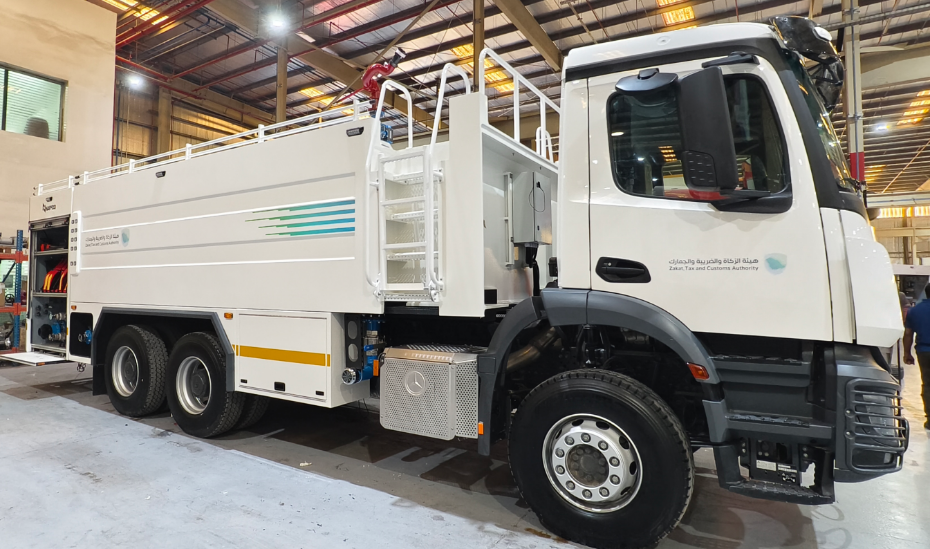
Fire truck water tanks must withstand vehicle vibration, repeated acceleration and braking, water movement, and changing outdoor conditions. For manufacturers, the challenge is not simply to fabricate a container, but to produce a tank with reliable welded joints, accurate dimensions, and dependable sealing performance.
In the NAFFCO project in the United Arab Emirates, the specified fire truck water tank dimensions are 7 × 1.6 × 2 m (L × W × H), with polypropylene (PP) as the selected material. The customer currently uses Röchling PP sheets, with a stated sheet size of 1600 × 5000 × 12 mm.
For a tank of this size, every manufacturing stage matters. Material selection determines fabrication compatibility; cutting and machining affect panel fit-up; welding determines joint integrity; and final inspection verifies whether the finished tank meets project requirements.
MM-TECH provides plastic sheet processing and welding equipment to support this workflow, helping manufacturers coordinate individual operations into a more consistent production process.
2. Raw Materials and PP Sheet Selection
The manufacturing process begins with selecting a thermoplastic material that meets the tank’s structural and operating requirements.
PP is widely used in industrial plastic fabrication because of its chemical resistance, relatively low weight, and suitability for welding when the material grade and process are compatible.
For fire truck water tanks, the selected grade must also meet the project’s requirements for stiffness, impact resistance, operating temperature, and outdoor exposure. Röchling PP sheets provide the specified material reference for the NAFFCO application. Before production, manufacturers should verify the sheet grade, thickness, dimensions, surface condition, and compatibility with the planned welding procedure. Establishing material requirements at the beginning gives the entire fabrication process a more reliable foundation.
3. Sheet Processing: Accurate Cutting and Machining
After material approval, the next stage is preparing the tank panels, bottom, cover, internal baffles, and reinforcement components.
For a 7-meter-long tank, inaccurate cutting or poor edge preparation can create assembly gaps and make welding more difficult. These problems may increase manual adjustment, extend production time, and affect the consistency of the finished structure.
The main processing operations include cutting sheets to drawing dimensions, preparing weld edges, machining openings, and producing accurately positioned baffles and reinforcement components.
The MM-TECH SWT-XL5000 Automatic Sheet Saw supports automatic plastic sheet cutting, helping manufacturers establish repeatable cutting operations. For more complex contours and openings, the SWT-YF2040 CNC Router, with a working size of 2000 × 4000 × 600 mm, supports CNC machining of plastic sheets.
The objective is to achieve accurate dimensions and consistent edge preparation before assembly. Better preparation reduces avoidable fitting problems and creates suitable conditions for subsequent welding.
4. Tank Assembly and Welding
The fabrication of a PP fire-truck water tank involves three key welding stages: tank body assembly and forming, baffle assembly and welding, and top cover and fittings welding. Each stage requires accurate alignment, suitable welding methods, and consistent control of weld quality to achieve the required tank geometry and sealing performance.
4.1 Tank Body Assembly and Forming
The tank body is formed by joining PP sheets according to the approved drawings. The main body is assembled by welding horizontal sheet connections and 90-degree corner joints.
During manual welding, the Weldy EX3 Plus Extrusion Welder provides adjustable extrusion speed, while the CX1600S BL and CX2000 BL Hot Air Welders are options for compatible hot-air welding tasks. For automatic welding requirements, the SWT-PH7000 Sheet Butt Fusion Welding Machine supports horizontal welding, circular welding, and 90-degree vertical jointing. The appropriate process depends on joint geometry, material compatibility, and production requirements.
4.2 Baffle Assembly and Welding
Baffles are installed inside the tank to help control water movement during vehicle acceleration, braking, and turning. Their positions and dimensions must follow the tank drawings, as incorrect placement can affect the intended internal layout and water-flow management.
After cutting and preparing the baffle plates, the components are positioned inside the tank and checked for alignment before welding. In the NAFFCO process, the internal structure is welded manually using extrusion welders and hot-air guns. This work requires careful handling because the internal joints may be difficult to reach, and the available working space becomes more restricted as assembly progresses.
The Weldy EX3 Plus, CX1600S BL, and CX2000 BL can support suitable manual welding operations. Where production volume, tank geometry, and joint accessibility justify mechanization, the MAW7000 Mechanical Arm Machine is designed to weld internal and external tank joints along the X, Y, and Z axes.
Before the tank is closed, the baffle positions and accessible welds should be inspected. Checking the internal structure at this stage makes it easier to identify and correct defects before the top cover limits access.
4.3 Top Cover and Fittings Welding
Once the tank body and internal baffles have been completed and inspected, the top cover is positioned and welded to close the tank. Correct alignment is essential to maintaining the intended dimensions and avoiding gaps or uneven joints. Welding should follow the specified procedure, with particular attention to continuity around the cover perimeter and the quality of joints at corners and transitions.
The SWT-PH7000 may be suitable for compatible horizontal or vertical sheet-welding configurations, while the SWT-ZW7000 can support applicable bending-welding operations where the design includes angled sections. Manual extrusion welding can also be used for the specified horizontal and 90-degree connections.
After the cover is secured, the required fittings—including inlets, outlets, drains, vents, and other designed connections—are welded into position. Each opening and fitting must be accurately located, properly prepared, and welded to provide a sound connection without compromising the tank structure.
For compatible pipe-to-flange applications, the SWT-FS250 Flange Welding Machine supports a welding size range of 140–250 mm. The IRW-250 Infrared Fusion Welding Machine, with a range of 110–250 mm, may be considered for suitable fusion-welding applications where a smaller weld bead, improved appearance, and higher welding quality are desired.
Where a flange connects to a metal pipe, an appropriate EPDM flange gasket must be installed between the mating flange surfaces. The SWT–JD2015 CNC Rubber Gasket Cutter automatically cuts EPDM flange gaskets to support gasket preparation. Correct gasket selection, alignment, and installation are essential to achieving the intended sealing performance.
5. Finished Tank Inspection and Quality Control
Once the panels, internal structure, cover, and fittings have been welded, the tank must undergo final inspection before delivery.
Key inspection activities include:
Dimensional inspection: Verify overall tank dimensions and mounting interfaces against the approved drawings.
Weld inspection: Check accessible horizontal seams, 90-degree corners, internal joints, and fitting connections for visible defects.
Leak testing: Conduct the specified water-fill or other approved leak test.
Connection verification: Check the positioning and assembly of inlets, outlets, drains, vents, and flanges.
Final documentation: Record inspection results against the project’s acceptance criteria.
A reliable tank depends on more than welding tools alone. Correct material selection, sound structural design, suitable reinforcement, qualified welding procedures, accurate gasket installation, and systematic quality control all contribute to the finished product.
For tanks fabricated through manual welding, consistent preparation and inspection are especially important to maintaining repeatable results.
6. Application Value and MM-TECH Equipment Solutions
Plastic water tanks manufactured from suitable thermoplastic materials may serve municipal fire engines, industrial firefighting vehicles, and specialized emergency response vehicles, subject to the design and applicable requirements.
Fabricating a large PP water tank for a fire truck requires more than welding equipment alone. Manufacturers need coordinated solutions for sheet cutting, machining, bending, joint welding, internal structure fabrication, and flange sealing. MM-TECH offers a range of plastic sheet processing and welding machines to support different stages of tank production.
6.1 Sheet Cutting and CNC Machining
Accurate sheet preparation is the foundation of reliable tank fabrication. Inconsistent dimensions, rough edges, and inaccurate openings can complicate assembly and increase the time required for joint preparation.
Automatic Sheet Saw – SWT-XL5000: Automatically cuts plastic sheets, supporting efficient material preparation before assembly.
CNC Router – SWT-YF2040: With a working size of 2000 × 4000 × 600 mm, this machine is designed for CNC machining of plastic sheets, including cutting and shaping operations required by the production design.
These machines can help manufacturers improve preparation efficiency and maintain consistent dimensions across multiple tank components.
6.2 Sheet Bending and Joint Welding
Tank fabrication involves horizontal seams, vertical corners, and, where the design requires, curved or bent sections. Selecting a suitable welding method and maintaining accurate alignment are essential to producing a tank with the required geometry.
Sheet Butt Fusion Welding Machine – SWT-PH7000: Supports horizontal welding, circular welding, and 90° vertical jointing. It provides configuration options for different sheet-joint requirements. It supports PP welding in accordance with DVS 2207-11, with a heated-tool temperature of 220°C, consistent with the range specified in the DVS 2207-11 standard.[1]
Sheet Bending Welding Machine – SWT-ZW7000: Supports bending welding from 0° to 95° on applicable configurations, helping integrate bending and welding operations where the tank design calls for angled sections.
6.3 Extrusion and Hot-Air Welding
Manual welding remains important when fabricating large tanks, particularly for internal structures, restricted-access areas, and joints that require careful operator control. The welding equipment must be suitable for the material, joint design, and welding procedure.
Extrusion Welder – Weldy EX3 Plus: Its extrusion speed can be adjusted to suit different welding requirements and operating conditions.
Hot Air Welder – CX1600S BL: Supports hot-air welding operations during plastic fabrication and assembly.
Hot Air Welder – CX2000 BL: Featuring a split design, it offers a more flexible welding solution for suitable fabrication tasks.
In the NAFFCO manufacturing process, internal tank structures were assembled and manually welded using extrusion welders and hot-air guns. Appropriate equipment selection, joint preparation, operator technique, and inspection are all important to achieving consistent weld quality.
6.4 Specialized Welding for Tank Joints
For manufacturers with suitable production requirements, MM-TECH also offers specialized welding equipment for particular joint configurations.
Infrared Fusion Welding Machine – IRW-250: Has a welding range of 110–250 mm. Its advantages include a smaller weld bead, improved appearance, and higher welding quality. Suitability depends on the component geometry, material, and applicable process requirements.
Mechanical Arm Machine – MAW7000: With a machine size of 7000 × 3000 × 2000 mm, it is designed to weld internal and external water-tank joints along the X, Y, and Z axes. This configuration may be considered for production requiring mechanized access to multiple joint positions.
Flange Welding Machine – SWT-FS250: Supports pipe-to-flange welding in the stated 140–250 mm size range. The required material compatibility and joint configuration should be confirmed before selection.
These machines address specialized production needs. The appropriate choice depends on tank dimensions, joint accessibility, required output, material compatibility, and the manufacturer’s welding procedure.
6.5 EPDM Gasket Cutting and Flange Sealing
Tank connections must be considered alongside the main tank welds. Where a flange connects to a metal pipe, a suitable EPDM flange gasket is required between the mating flange surfaces to provide the intended seal.
CNC Rubber Gasket Cutter – SWT-JD2015: Automatically cuts EPDM flange gaskets, helping prepare gasket components consistently for flange connections.
Accurate gasket cutting, correct installation, suitable flange alignment, and appropriate tightening are all important to the sealing performance of the finished assembly. Gasket selection should also be checked against the service medium, temperature, and operating conditions.
6.6 An Integrated Approach to Tank Fabrication
MM-TECH’s equipment range covers several key stages of plastic tank production—from automatic sheet cutting and CNC machining to bending, sheet welding, extrusion welding, hot-air welding, specialized joint welding, and gasket preparation. Rather than treating every machine as necessary for every project, manufacturers can select a combination based on tank design, sheet thickness, joint geometry, production volume, and quality requirements.
For projects such as the NAFFCO fire-truck water tank, the first step is to confirm the final PP sheet specification, tank drawings, joint details, and sealing requirements. The equipment configuration can then be matched to the required fabrication process.
Planning a plastic fire truck water tank production line?
Contact MM-TECH to discuss your tank dimensions, PP sheet specifications, manual welding requirements, flange connections, and production goals. MM-TECH can help evaluate suitable equipment configurations to support a more organized and consistent plastic tank manufacturing process.
Reference
[1]DVS 2207-11, Welding thermoplastic materials — Heated element welding of pipes, piping parts and panels made of PP, Deutscher Verband für Schweißen und verwandte Verfahren e.V. (DVS).