1. Why Plastic Sheet Fabrication Is Transforming Swimming Pool Manufacturing
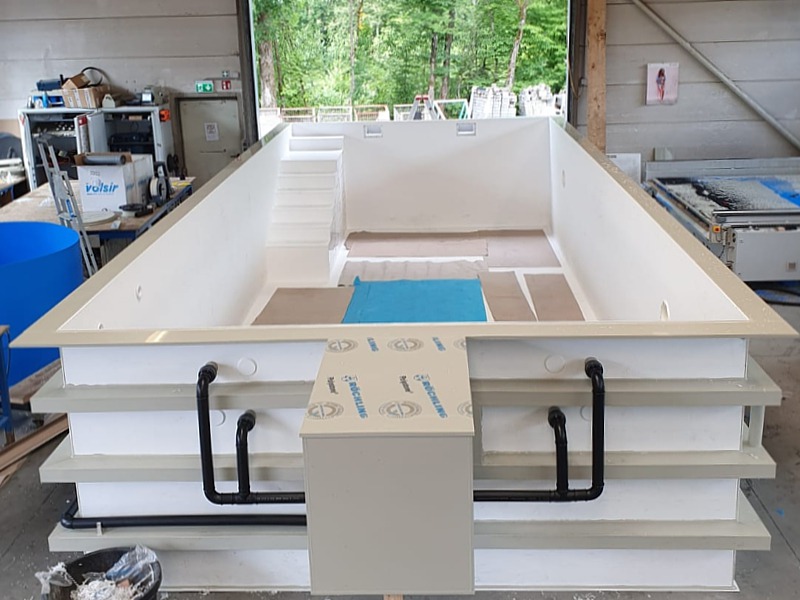
Swimming pool manufacturers are increasingly looking for materials and fabrication methods that combine durability, design flexibility, efficient production, and an attractive finish. Traditional pool construction methods can involve complex installation procedures, multiple materials, and maintenance-intensive joints. Welded thermoplastic sheet construction offers an alternative for manufacturers producing prefabricated, modular, and custom-designed swimming pools.
A plastic sheet swimming pool must withstand continuous water contact, hydrostatic pressure, chlorine-based disinfection, temperature fluctuations, and outdoor exposure. Its performance depends on more than the plastic material itself. Accurate sheet cutting, consistent welding, well-designed reinforcement, and reliable pipe connections all contribute to the quality of the finished pool.
For manufacturers, the challenge is to transform individual plastic sheets into a strong, watertight structure while maintaining dimensional accuracy and an attractive surface finish.
MM-Tech provides a comprehensive range of plastic sheet cutting, welding, bending, and pipe fusion equipment to support this manufacturing process. From preparing large-format panels to joining pool walls and fabricating circulation pipework, the right equipment helps streamline production and improve manufacturing consistency.
2. Raw Materials and Sheet Selection
Choosing the Right Plastic for Swimming Pools
Polypropylene (PP) and high-density polyethylene (HDPE) are widely used in thermoplastic fabrication. Both offer good chemical resistance and weldability, but their properties differ.
PP is valued for its mechanical strength, relatively low weight, chemical resistance, and suitability for welded sheet structures. HDPE is known for its toughness, impact resistance, and flexibility. For outdoor swimming pools, UV stabilization and long-term resistance to pool chemicals are essential considerations.
The choice should account for the pool’s design, water treatment system, operating temperature, outdoor exposure, and expected service life.
Recommended Swimming Pool Sheets: Röchling Polystone® P PG and PGX
Röchling Polystone ® P (Copolymer) PG and Polystone ® P (Copolymer) PGX pool grades are excellent choices for PP swimming pool construction.
According to Röchling’s product information, both grades combine high mechanical strength and good weldability with resistance to chlorine and UV radiation.
Polystone® P PG
- High mechanical strength for swimming pool panel fabrication.
- Good weldability for producing joined sheet structures.
- High resistance to chlorine and UV radiation.
- Available in smooth and grained, barefoot-friendly surface finishes.
Polystone® P PGX
- High mechanical strength and good weldability.
- Very high resistance to chlorine and UV radiation.
- Available in smooth and grained surfaces, with an additional three-dimensional Cubic grain option.
- Suitable for swimming pool designs requiring different surface appearances and finishes.
Both grades are available in various colors and dimensions, including blue, white, and grey options. Röchling lists sheet formats such as 4,000 × 1,500 mm and 3,000 × 1,500 mm in various thicknesses.
The smooth finish supports a clean, contemporary appearance, while grained surfaces provide a barefoot-friendly texture for selected pool areas.
By starting with dedicated swimming pool sheet grades, manufacturers can build a more consistent production process around material selection, welding, surface quality, and finished appearance.
3. Plastic Sheet Processing Before Welding
Accurate fabrication begins before the first weld. Sheet dimensions, edge quality, component positioning, and opening locations all influence the efficiency of pool assembly.
Automatic Sheet Cutting
The first step is cutting the raw sheets into the components required for the pool structure, including the bottom panels, sidewalls, end panels, steps, and reinforcement elements.
The MM-Tech SWT-XL4000 Automatic Sheet Saw supports automated sheet cutting for repeatable component preparation. Accurate cutting helps reduce manual layout work, improves material utilization, and prepares panels for subsequent welding and assembly.
CNC Routing
Pool construction also requires openings for drains, water inlets, return lines, and other fittings. Some designs include custom-shaped steps, corners, and accessory panels.
SWT-YF1530 CNC Router can machine these features according to the production drawings, helping manufacturers maintain consistent positioning and reduce rework during assembly.
Although CNC routing is a separate processing operation, it directly supports the accuracy of subsequent welding and pipe installation.
4. Pool Manufacturing and Welding Process
Welding is the central stage in plastic swimming pool fabrication. The bottom, sidewalls, corners, reinforcement elements, and pipework must work together to form a stable, watertight structure.
Step 1: Joining the Main Pool Panels
The manufacturing process begins by preparing the bottom and wall panels according to the pool layout. When a panel exceeds the dimensions of an individual sheet, multiple sheets can be joined to create larger components.
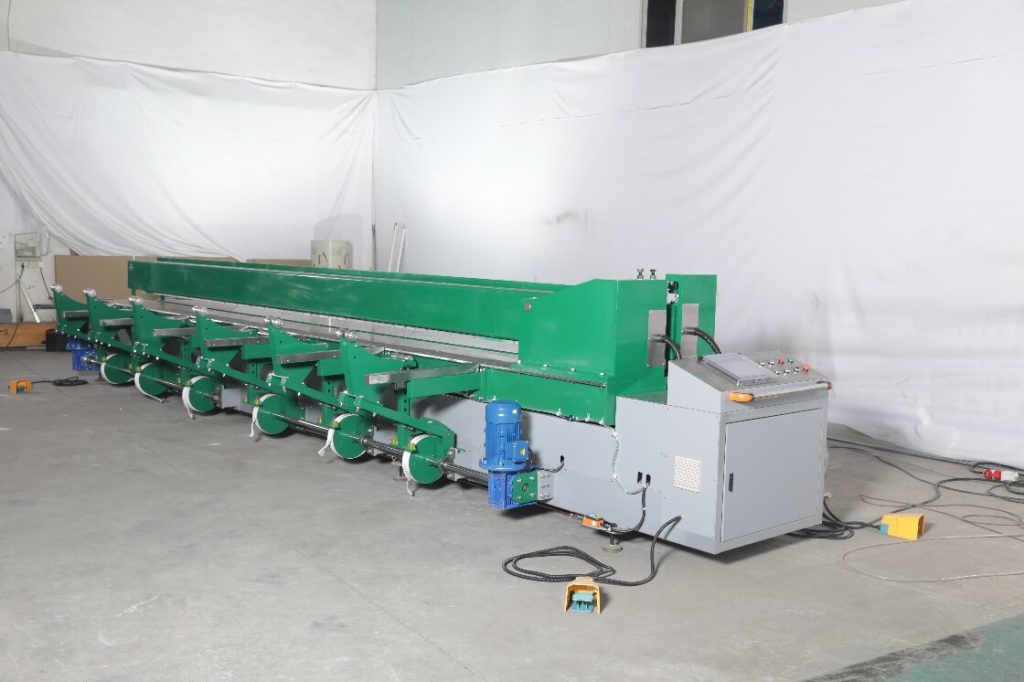
The MM-Tech SWT-PH6000 Sheet Butt Fusion Welding Machine is designed for thermoplastic sheet butt fusion and supports large-panel welding operations. Its six-meter working configuration and independently controlled clamping sections help manufacturers position and secure panels during welding. For PP swimming pool sheets, heated-tool welding procedures can be based on the relevant provisions of DVS 2207-11, which covers heated-element welding of PP pipes, fittings, and panels.
Accurate alignment, consistent heating, and controlled joining help establish a reliable foundation for the remaining pool assembly.
Step 2: Bending and Forming Pool Components
Once the required panels have been prepared, selected components can be bent to create the intended geometry.
The MM-Tech SWT-ZW6000 Sheet Bending Welding Machine supports large-format thermoplastic sheet bending, with a maximum bending length of 6,000 mm, a bending thickness range of 3–25 mm, and adjustable bending angles up to 95°. Its bending capability supports the production of folded components and selected pool features. DVS 2207-14 provides relevant guidance for the welding procedure.
Integrating bending and forming into the production workflow can reduce separate handling operations and help manufacturers maintain consistent component geometry.
Step 3: Welding Pool Walls, Corners, and Reinforcement
After panel preparation, the pool walls are positioned and assembled around the bottom structure. The corners and bottom-to-wall joints form critical parts of the pool shell.
The MM-Tech SWT-NS630A Extrusion Welder supports the welding of major structural seams, including suitable panel joints, corners, and reinforcement connections. Extrusion welding introduces molten thermoplastic filler material into the prepared joint, helping form a continuous welded seam. For PP fabrication, DVS 2207-4 provides guidance on extrusion welding of thermoplastic pipes, fittings, and panels.
The MM-Tech SWT-NS1600BM Hot Air Welder complements this process by supporting hot-gas welding for local joints, smaller components, and detailed fabrication work. For PP sheet fabrication, DVS 2207-3 provides guidance on hot-gas welding. Using established welding procedures helps manufacturers standardize their process and improve repeatability across production batches.
Reinforcement is another essential part of pool construction. External ribs, perimeter supports, and other structural elements help control wall deflection under water pressure. Their arrangement should be established through engineering calculations rather than relying on weld strength alone.
Step 4: Fabricating the Pool Circulation System
A swimming pool requires a coordinated circulation system to maintain water movement and filtration. Depending on the design, the pipework may include water inlets, return lines, drains, and connections to filtration equipment.
The MM-Tech SWT-V355 Pipe Butt Fusion Welding Machine joins compatible thermoplastic pipes by heating their ends and pressing them together under controlled conditions. The model is listed for pipe diameters of 90–355 mm and supports PP, PE, and PVDF pipe welding. For PP pipework, DVS 2207-11 provides a relevant heated-element welding reference.
The MM-Tech ZDRJ-315 Electrofusion Welding Machine provides another connection method for pipe systems. With a welding range of 20–315 mm, it ensures strong, leak-proof joints by fusing pipe ends with built-in heating elements. Its barcode input options and welding record storage help improve process traceability.
Using dedicated pipe fusion equipment helps manufacturers prepare circulation components efficiently and integrate the pipework into the completed pool system.
5. Finished Pool Inspection and Application Value
Once fabrication is complete, the pool should undergo a structured inspection process.
Key checks include:
Weld quality: Inspect the main seams, corners, reinforcement joints, and accessory connections.
Dimensional accuracy: Verify the pool geometry, panel alignment, and installation openings.
Structural integrity: Confirm that the reinforcement and support arrangement follows the approved structural design.
Pipework integrity: Inspect the circulation system and check connections for leakage.
Water testing: Conduct a controlled filling test and monitor leakage, wall movement, and deformation according to the project test plan.
A well-organized manufacturing process helps pool producers improve product consistency, reduce rework, and deliver a more professional finished product.
Welded thermoplastic pools can serve a range of applications, including residential gardens, hotels, leisure facilities, commercial installations, and customized pool projects. Their modular construction and flexible sheet fabrication also create opportunities for producing different shapes, colors, steps, and integrated features.
6. MM-Tech Complete Equipment Solutions for Swimming Pool Manufacturing
MM-Tech offers a coordinated equipment lineup covering the major production stages, from panel preparation to pool structure welding and circulation pipe fabrication.
| Manufacturing stage | MM-Tech equipment | Main role |
| Sheet cutting | SWT-XL4000 Automatic Sheet Saw | Cuts pool panels and reinforcement components. |
| CNC machining | SWT-YF1530 CNC Router | Machines contours and openings. |
| Panel joining | SWT-PH6000 Sheet Butt Fusion Welding Machine | Joins plastic sheets into larger panels; supports horizontal, circular welding and 90° vertical jointing. |
| Panel bending and forming | SWT-ZW6000 Sheet Bending Welding Machine | Produces controlled bends and selected folded components. |
| Structural welding | SWT-NS630A Extrusion Welder | Welds major panel seams and reinforcement joints. |
| Detail welding | SWT-NS1600BM Hot Air Welder | Supports local hot-gas welding and detailed fabrication. |
| Pipe joining | SWT-V355 Pipe Butt Fusion Welding Machine / ZDRJ-315 Electrofusion Welding Machine | Joins thermoplastic pipe sections for circulation systems by butt-fusing / electrofusing. |
The value of this equipment combination lies in process integration. Cutting, forming, welding, and pipe fabrication can be organized around a consistent production workflow rather than handled as isolated operations.
MM-Tech’s welding equipment series also offers configurations for different working dimensions and fabrication requirements, allowing manufacturers to develop production solutions around their target pool sizes and product range.
For businesses expanding into plastic swimming pool production, equipment selection should consider panel dimensions, sheet thickness, pool design, production volume, welding processes, and workshop layout.
MM-Tech can help manufacturers evaluate the required machine configuration and plan an equipment solution that supports their production goals.
7. Build Better Plastic Swimming Pools with MM-Tech
Producing a high-quality plastic swimming pool requires more than suitable raw materials. The complete process—from sheet selection and accurate cutting to panel joining, structural welding, reinforcement, and pipe installation—determines the consistency and reliability of the finished product.
Röchling Polystone® P PG and PGX provide dedicated PP sheet options for swimming pool construction, combining mechanical strength, weldability, and resistance to chlorine and UV radiation. Paired with an organized manufacturing process and appropriate welding procedures, these materials offer a strong foundation for customized pool fabrication.
With the SWT-XL4000 Automatic Sheet Saw, SWT-YF1530 CNC Router, SWT-PH6000 Sheet Butt Fusion Welding Machine, SWT-ZW6000 Sheet Bending Welding Machine, SWT-NS630A Extrusion Welder, SWT-NS1600BM Hot Air Welder, SWT-V355 Pipe Butt Fusion Welding Machine, and ZDRJ-315 Electrofusion Welding Machine, MM-Tech supports the key stages of plastic pool manufacturing through one coordinated equipment solution.
Planning to manufacture plastic swimming pools or expand your thermoplastic fabrication capabilities?
Contact MM-Tech to discuss your pool design, material selection, production requirements, and equipment configuration. Our team can help you identify a suitable manufacturing solution for your workshop and production goals.
MM-Tech — Your Partner in Plastic Sheet Fabrication and Welding Solutions.