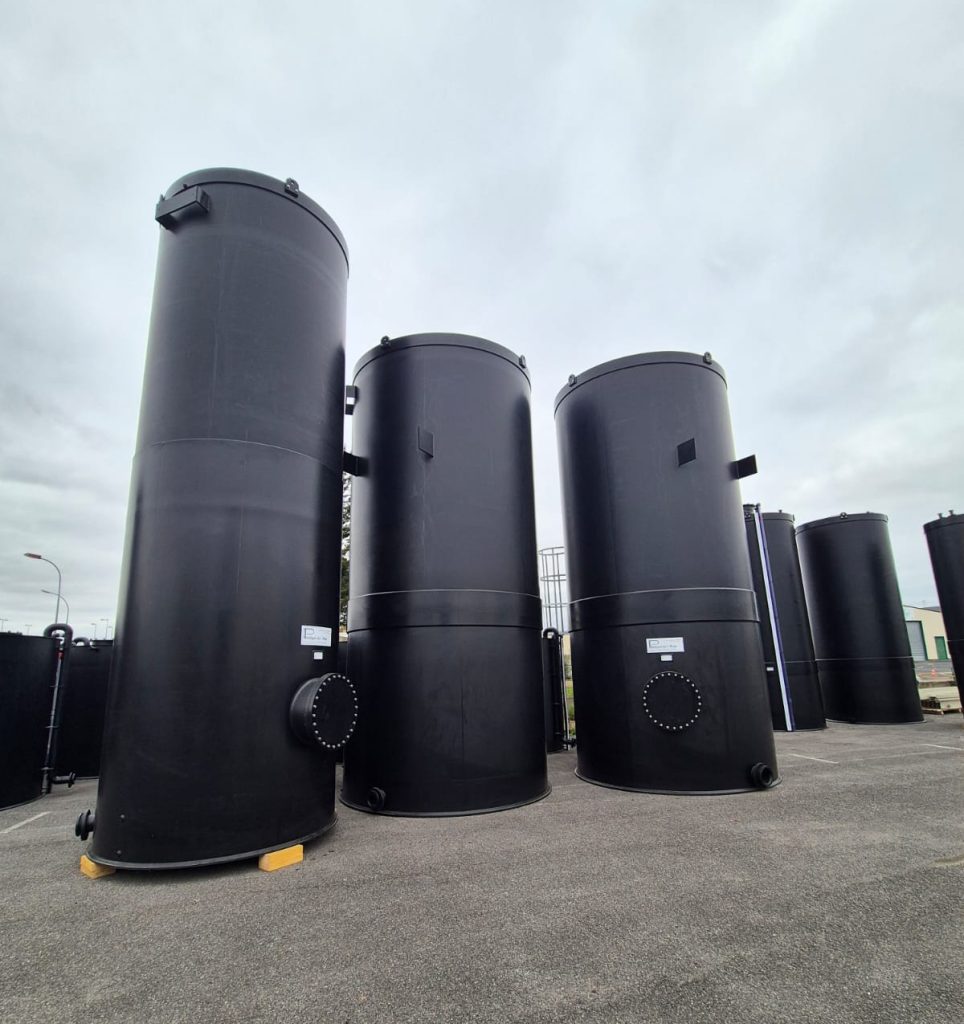
Plastic chemical storage tanks are widely used in chemical processing, water treatment, electroplating, and industrial wastewater management. Compared with conventional metal tanks, thermoplastic tanks can offer excellent corrosion resistance, relatively low weight, and flexible fabrication options when the material is properly selected for the service conditions.
However, manufacturing a reliable plastic tank requires more than selecting a corrosion-resistant sheet. Material compatibility, sheet preparation, dimensional accuracy, welding quality, and connection design all influence the finished tank’s performance.
MM-Tech provides plastic sheet processing and welding equipment to support manufacturers throughout the tank fabrication process, from raw sheet preparation to tank assembly and piping connections.
1. Understanding Chemical Storage Tank Manufacturing Requirements
Chemical storage tanks operate under different conditions depending on the stored medium and the installation environment. Some handle acidic or alkaline solutions, while others are used for industrial wastewater, chemical dosing, or process liquids.
Manufacturers must consider several factors before production:
Chemical compatibility: The tank material must resist the specific chemical, its concentration, and the operating temperature.
Mechanical strength: Sheet thickness, tank diameter, liquid height, support structure, and design loads must be considered together.
Weld integrity: Poor edge preparation, inconsistent heating, contamination, or unsuitable welding parameters can compromise joint quality.
Dimensional accuracy: Incorrect cutting or assembly can result in misaligned seams, uneven connections, and difficulties when installing pipes and fittings.
Leak prevention: Tank seams, bottom connections, nozzles, and flanges require appropriate joint designs and inspection procedures.
For manufacturers, the challenge is to achieve consistent fabrication quality while controlling production time, material waste, and rework. A coordinated combination of sheet processing, welding, and piping equipment helps address these challenges.
2. Raw Materials and Plastic Sheet Selection
The manufacturing process begins with selecting a thermoplastic material suitable for the intended application.
Common Materials for Plastic Chemical Tanks
Polypropylene (PP)
PP is widely used in industrial tank fabrication because of its chemical resistance, relatively low density, and suitability for thermoplastic welding. Depending on the grade, it can be used for many acid, alkali, and process-liquid applications. Its temperature limits, impact performance, and outdoor durability must be evaluated for the actual operating conditions.
High-Density Polyethylene (HDPE)
HDPE combines chemical resistance, low weight, and good impact resistance. It is commonly considered for water treatment, industrial wastewater, and compatible chemical storage applications. Its flexibility and thermal expansion characteristics should be considered when designing the tank and its support structure.
Polypropylene Homopolymer (PP-H)
PP-H is frequently used in industrial chemical equipment where stiffness, chemical resistance, and fabrication performance are important. The appropriate grade depends on the chemical medium, temperature, and structural requirements.
Polyvinylidene Fluoride (PVDF)
PVDF is selected for demanding chemical environments and applications requiring high chemical purity or resistance to particular aggressive media. Its higher material cost makes careful application-based selection especially important.
Commercial sheet suppliers, including established industrial thermoplastic manufacturers such as Röchling, SIMONA and AGRU, offer products in different grades and dimensions. The specific sheet grade must be verified against the tank’s service requirements. For example, Röchling Polystone G black B 100-RC is an excellent choice for chemical storage tanks. It is a PE 100 with significant higher stress cracking resistance. Only raw materials are used which are approved for tank building. The properties of Polystone G black B 100-RC are as follows:
- High elongation at break, very suitable for tank building
- Good chemical resistance
- Approved in Germany for tanks requiring mandatory test certificates according to § 63 WHG
- High resistance against stress cracking (FNCT > 8760 h)
What Should Manufacturers Check?
Before fabrication, confirm the material grade, sheet thickness, dimensions, surface condition, and compatibility of the welding material with the base sheet.
Sheet thickness is determined by engineering calculations and the applicable design requirements rather than a universal standard range. Density, operating temperature, chemical concentration, UV exposure, and long-term mechanical loading should also be considered.
For high-purity or sensitive process applications, material cleanliness and any applicable product-contact requirements may introduce additional specifications.
3. Sheet Processing Before Welding
Accurate sheet preparation establishes the foundation for reliable tank fabrication. Errors introduced during cutting or edge preparation can make subsequent welding more difficult and increase the risk of rework.
Step 1: Sheet Cutting and Nesting
The sheet layout is planned according to the tank diameter, height, bottom dimensions, cover design, and available sheet sizes.
The MM-Tech SWT-XL5000 Automatic Sheet Saw is used for cutting sheets into desired sizes, while the SWT-YF2040 CNC Router supports programmed contour machining, openings, and other features requiring CNC processing.
These machines help manufacturers prepare consistent components and organize cutting operations more efficiently.
Step 2: Edge Preparation
Before welding, the joint edges must be prepared according to the selected welding method. Depending on the joint design, this may involve milling, trimming, cleaning, and preparing the required groove or edge geometry.
Clean, accurately prepared edges improve fit-up and help establish consistent welding conditions. Dust, oil, moisture, and other contamination should be removed as required by the welding procedure.
4. Welding Processes for Chemical Storage Tanks
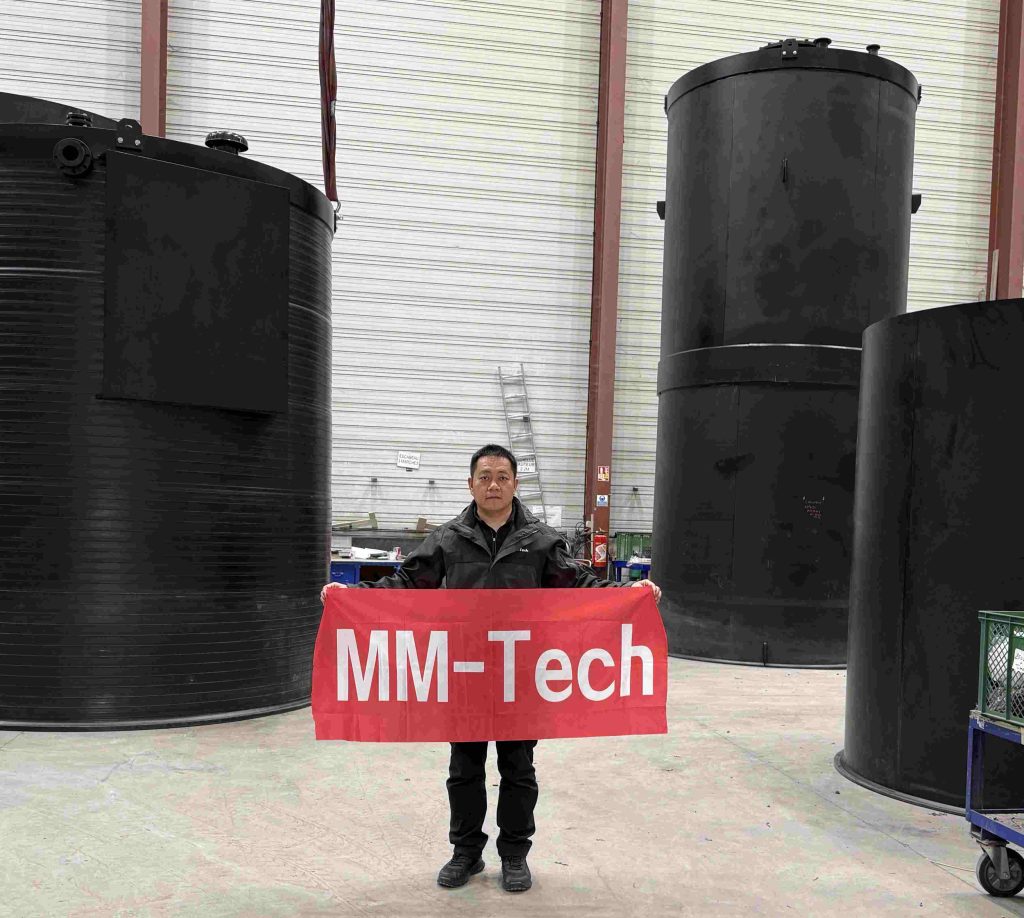
Welding is one of the most important stages in plastic tank fabrication. Different joints require different methods, depending on the sheet material, thickness, geometry, accessibility, and design requirements.
Step 1: Shell Forming and Welding
The MM-Tech SWT-PH6000 Sheet Butt Fusion Welding Machine handles heated-tool butt fusion of compatible thermoplastic sheets, joining individual panels into larger sheets. Per DVS 2207-1 (PE) and DVS 2207-11 (PP), the machine controls heating time, changeover time, joining pressure and pressure-maintained cooling to form a uniform melt layer and full fusion. It supports horizontal and circular welding and, on request, 90° vertical jointing of panels.
For cylindrical tanks, the welded panels are rolled on automatic sheet rolling devices into a round shell, followed by longitudinal seam closure of the cylinder shell via butt fusion. For rectangular tanks, panels are bent to 0°–95° on the SWT-ZW6000 Sheet Bending Welding Machine, following the heated-tool bending guidance of DVS 2207-14.
Joints better suited to extrusion welding are completed with the EX3 Plus Extrusion Welder, using filler rod matched to the base polymer grade; preheat, filler deposition and bead-forming parameters are set in line with DVS 2207-4.
The objective is consistent joint preparation, controlled welding parameters and repeatable seam quality throughout the tank shell. Incoming sheets and filler rods are inspected per DVS 2201-1, welding is performed by operators qualified under DVS 2212-1 or to EN 13067:2020, and wall thickness with weld joint efficiency is established according to DVS 2205.
Step 2: Tank Bottom and Shell Welding
The prepared shell is positioned on the tank bottom, with alignment and support established before joining.
Extrusion welding is commonly considered for suitable thermoplastic tank joints, including certain bottom-to-shell connections. The EX3 Plus Extrusion Welder can support these operations when the material, joint preparation, and welding procedure are compatible.
The MM-Tech SWT-NS2000 Hot Air Welder is used for localized jointing and manual hot-gas welding operations in accordance with DVS 2207-3.
The welding procedure should account for joint geometry, material compatibility, heat input, and access to the seam. The bottom connection deserves particular attention because it is important to the tank’s containment performance.
Step 3: Cover, Nozzle, and Component Welding
After the main tank structure has been assembled, the cover, inlet and outlet nozzles, drain connections, vents, and other accessories are installed according to the design.
The MM-Tech SWT-ZW6000 Sheet Bending Welding Machine, with a bending range of 0–95°, can support the fabrication of suitable tank components, including formed edges and structural parts.
The EX3 Plus Extrusion Welder and SWT-NS2000 Hot Air Welder can support suitable plastic joints around these components. The chosen method depends on the component geometry, required weld configuration, and accessibility.
Nozzle positioning and reinforcement details should follow the tank drawing. Flanged connections must also be designed for the intended piping system, including suitable sealing arrangements where required.
Step 4: Piping and Fitting Fabrication
Chemical storage systems often include connected pipes for filling, discharge, drainage, overflow, and process transfer. These components must be fabricated from compatible materials and connected using appropriate joining methods.
The MM-Tech SWT-V315 Pipe Butt Fusion Welding Machine supports compatible plastic pipe butt-fusion applications with a welding range of 90-315 mm. It joins pipe sections for filling, discharge and drainage lines.
The ZRJQ-63 Socket Fusion Welding Machine is intended for PPR, PE and PB pipe and fitting socket-fusion applications with the size range of 20-63 mm. Compliant with the DVS 2208-1 standard, the machine assures welding reliability.
Where custom elbows, tees, or other fittings are required, manufacturers should select suitable fitting fabrication equipment and procedures according to the piping design.
Pipe welding is not interchangeable with sheet welding. Pipe dimensions, wall thickness, joint type, and equipment capacity must all be checked before production.
5. MM-Tech Equipment Solutions for Tank Fabrication
A practical equipment configuration should match the complete manufacturing workflow rather than focus on one machine in isolation.
| Manufacturing stage | Recommended MM-Tech equipment | Main role |
| Sheet cutting | SWT-XL5000 Automatic Sheet Saw | Cutting sheets into desired sizes |
| CNC machining | SWT-YF2040 CNC Router | Machining contours, openings, and programmed features |
| Sheet bending | SWT-ZW6000 Sheet Bending Welding Machine | Bending plastic sheets through 0°–95° for rectangular tanks, corners and formed edges |
| Sheet butt welding | SWT-PH6000 Sheet Butt Fusion Welding Machine | Butt-fusing plastic sheets into large panels; horizontal, circular welding and 90° vertical jointing |
| Extrusion welding | EX3 Plus Extrusion Welder | Extrusion-welding bottom-to-shell corners, nozzle fillets and reinforcement joints with matching filler rod |
| Hot-air welding | SWT-NS2000 Hot Air Welder | Tacking, localized joints around nozzles and fittings, and repair welds on sheets |
| Pipe butt fusion | SWT-V315 Pipe Butt Fusion Welding Machine | Butt-fusing pipes from 90 to 315 mm for filling, discharge and drainage lines |
| Pipe socket fusion | ZRJQ-63 Socket Fusion Welding Machine | Socket-fusing PPR, PE and PB pipes and fittings from 20 to 63 mm |
This equipment combination covers many of the key operations involved in plastic tank and piping fabrication. The final configuration should be adjusted to the manufacturer’s production volume, tank dimensions, material selection, joint design, and required level of automation.
MM-Tech equipment selection should be based on verified machine specifications and the intended process. Not every tank requires every machine, and certain forming or inspection operations may require additional equipment.
6. Finished Tank Quality and Industrial Applications
Once welding and assembly are complete, the tank should undergo inspection in accordance with its design documents and applicable requirements.
Typical checks include:
Dimensional inspection: Verify tank dimensions, roundness, alignment, and nozzle locations.
Visual weld inspection: Examine weld appearance, continuity, and visible defects.
Joint and leakage verification: Apply the inspection or leak-testing method specified for the tank design and service conditions.
Piping and fitting checks: Confirm connection alignment, flange installation, and sealing arrangements.
Documentation: Record relevant material information, welding procedures, and inspection results.
Appropriate material selection, careful fabrication, and controlled welding can help manufacturers produce tanks suited to their intended service conditions. Actual service life and containment performance depend on material compatibility, design, operating conditions, installation, and maintenance.
Plastic chemical storage tanks are used in a variety of industries, including:
- Chemical processing and chemical storage
- Industrial wastewater treatment
- Water treatment and environmental engineering
- Electroplating and surface treatment
- Industrial liquid dosing and transfer systems
- Compatible specialty chemical and process-liquid applications
The material and tank design must be validated for the specific chemical medium, concentration, temperature, and loading conditions.
7. Build Your Plastic Tank Fabrication Solution with MM-Tech
Manufacturing a reliable plastic chemical storage tank requires coordinated control of material selection, sheet preparation, forming, welding, and piping integration. Choosing appropriate equipment for each stage can help improve production consistency, reduce avoidable rework, and support a more organized manufacturing workflow.
Trusted by European fabricators such as Plastiques de l’Aisne in France, MM-Tech offers plastic sheet welding and processing equipment for manufacturers working with thermoplastic sheets, tank structures, and piping systems.
Whether you are establishing a new tank fabrication workshop or upgrading an existing production line, the right equipment configuration starts with understanding your product requirements.
Contact MM-Tech to discuss your tank fabrication project. Share your tank diameter, height, material, sheet thickness, piping specifications, and production requirements. Our team can help you evaluate suitable equipment options for your manufacturing process.