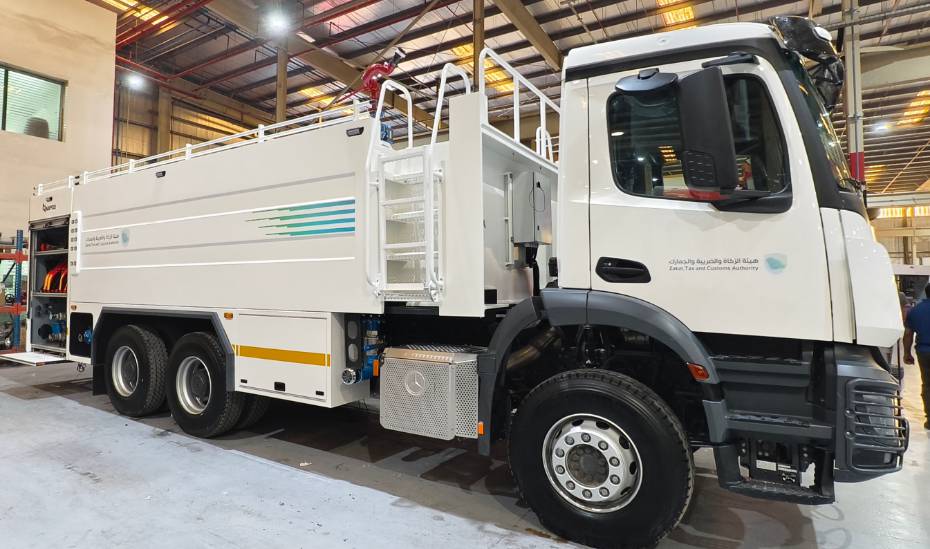
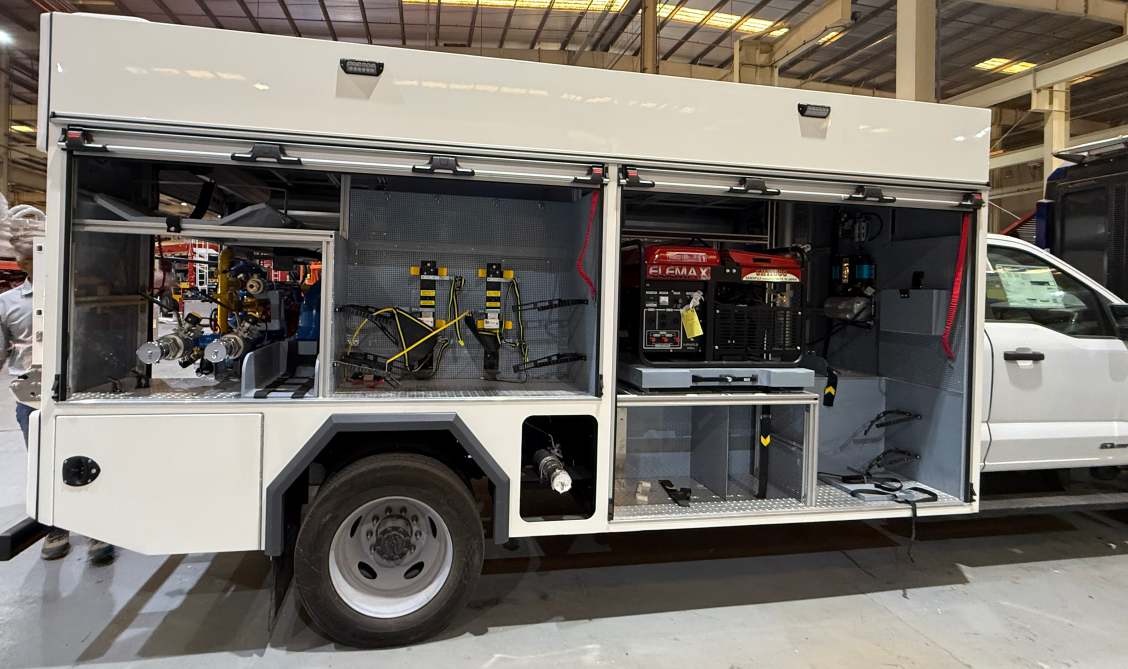
A fire truck water tank must hold its contents under vibration, impact, and constant motion. Tank failure during an emergency means lost water capacity and compromised firefighting response. Fabricators face several recurring challenges in fire truck water tank welding solutions.
|
Challenge Area |
Specific Fabrication Challenge |
|---|---|
|
Material selection |
Sheet grade must satisfy stiffness, impact resistance, operating temperature, and outdoor exposure requirements. |
|
Cutting & edge preparation |
Inaccurate cutting on long tanks creates assembly gaps, increases manual adjustment, and extends production time. |
|
Welding alignment & joint access |
Internal baffle joints are hard to reach, and working space tightens as assembly progresses. |
|
Leak prevention (gaskets) |
EPDM flange gaskets must be correctly selected, cut, aligned, and tightened. |
A reliable tank depends on more than welding tools alone. Correct material selection, sound structural design, suitable reinforcement, qualified welding procedures, accurate gasket installation, and systematic quality control all contribute to the finished product.
This guide provides a practical, step-by-step path from sheet selection through complete welding and inspection.
Key Takeaways
-
Choose high-quality PP sheets with verified thickness and UV resistance for a strong tank.
-
Cut and prepare edges accurately to ensure tight fits and strong welds.
-
Follow a fixed welding sequence: body, baffles, then top cover and fittings.
-
Inspect every weld visually and test for leaks to guarantee tank integrity.
-
Use the right equipment for each task to build a reliable fire truck water tank.
Selecting PP Sheets for Water Tanks
Why PP Sheets
Polypropylene earns its place in fire truck water tanks for three reasons. First, PP resists most aqueous solutions, alkalis, and inorganic acids, even at elevated temperatures. It is unaffected by most forms of corrosion, which gives it an edge over metals. Second, high-impact copolymer PP absorbs road vibration and resists cracking, a critical trait for a tank that travels on rough ground. Third, PP is easy to machine, fabricate, and weld, and matching welding rods are available in multiple formulations.
|
Attribute |
What It Means for a Water Tank |
|---|---|
|
Chemical resistance |
Copolymer PP offers stain and chemical resistance with low moisture absorption. |
|
Impact strength |
High-impact, no-break copolymer PP provides durability and versatility. |
|
Weldability |
The sheet machines and welds easily, and matching rods are supplied. |
|
Application fit |
PP sheet is explicitly listed for fire truck bodies and tanks. |
Copolymer grades suit fire truck tanks well. They are inexpensive, easy to fabricate, and resist cracking from road vibration. Homopolymer PP brings a high strength-to-weight ratio and excellent chemical resistance for corrosive environments. Successful thermoplastic welding also requires filler rods made from the same high-grade resin as the base material, so confirm rod compatibility at the sheet selection stage.
Key Properties to Evaluate
Check thickness at multiple points, not only the center. Uneven thickness can cause weak forming, bending, or installation problems later. Outdoor-grade PP sheet typically shows a density near 0.90–0.91 g/cm³, which confirms a lightweight option; verify grade consistency across batches.
Surface uniformity and color consistency affect both appearance and performance, so inspect edges and surface finish. For UV stability, request the test method, exposure duration, sample thickness, and lab details. A broad “UV resistant” claim is not a complete specification. Additional checks include tensile strength around 25–35 MPa, continuous service temperature near −20°C to 80°C, and water absorption typically below 0.1% after 24 hours. Inspect samples after cutting, drilling, and repeated temperature changes to reveal warping or brittle edges.
Sheet quality directly affects weld integrity in later stages. Request batch records, additive details, and test conditions before large-scale purchasing.
Cutting and Machining PP Sheets
Accurate cutting sets the foundation for every weld that follows. PP sheets for fire truck tanks are long and wide, so a handheld knife cannot hold a straight line over the full panel length. Two machines handle this work in a professional shop. The SWT-XL5000 automatic sheet saw cuts sheets into the desired sizes with repeatable, square edges. The SWT-YF2040 CNC router carves the desired shapes on sheets, including openings for fittings and access points. Both machines follow a program, so every panel in a batch matches the drawing. Consistent cuts reduce manual trimming and keep panel edges parallel.
Edge preparation comes next, and it deserves the same care as the cut itself. Follow these steps before any welding begins:
-
Square each edge and confirm it against the tank drawing.
-
Deburr cut edges to remove burrs and rough spots left by the saw or router.
-
Clean the weld zone to remove dust, chips, and handling marks.
A clean, square edge lets the welding tool sit flat against the joint. Contamination trapped at the joint can weaken the weld seam.
Fit-up tolerances decide whether fusion welding succeeds. Panels must meet with minimal gap and correct alignment along the full joint length. A wide gap forces the welder to fill space instead of fusing material, and the result is a weak seam. Misalignment between panels creates a step that stresses the joint during service. Dry-fit the panels before welding and check the joint line along its entire length. Correct any gap or offset at this stage. Small errors here grow into leaks later.
Assembling and Welding the Tank
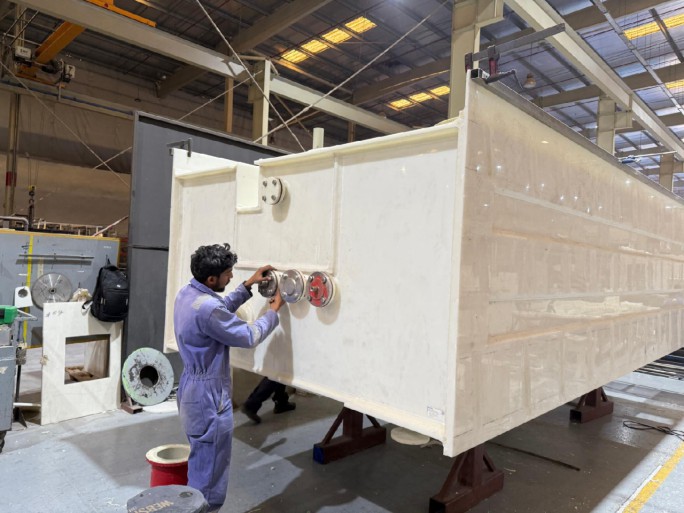
Tank assembly proceeds in three welding stages: body assembly and forming, baffle assembly and welding, then top cover, fittings, and flanges. Each stage builds on the fit-up accuracy established during cutting. These fire truck water tank welding solutions follow a fixed order. A disciplined sequence keeps joints accessible and prevents rework.
Body Assembly and Baffle Welding
Body panels join through sheet butt fusion welding. The SWT-PH7000 sheet butt fusion welding machine handles thermoplastic sheets including PE, PP, PVC, PVDF, PC, ABS, and acrylic. It supports horizontal and circular welding, plus 90-degree vertical jointing when specified. The SWT-ZW7000 sheet bending welding machine bends thermoplastic sheets from 0 to 95 degrees. This capability forms corners and shaped sections without separate forming equipment. Both machines establish the tank shell geometry before internal work begins.
Baffles come next. Fire truck water tanks should feature NFPA-compliant internal baffling, and all baffles should be extrusion welded to meet safety and structural requirements. Install baffles and extrusion weld them before fittings and piping go in. This order protects structural integrity and keeps the joint area clear.
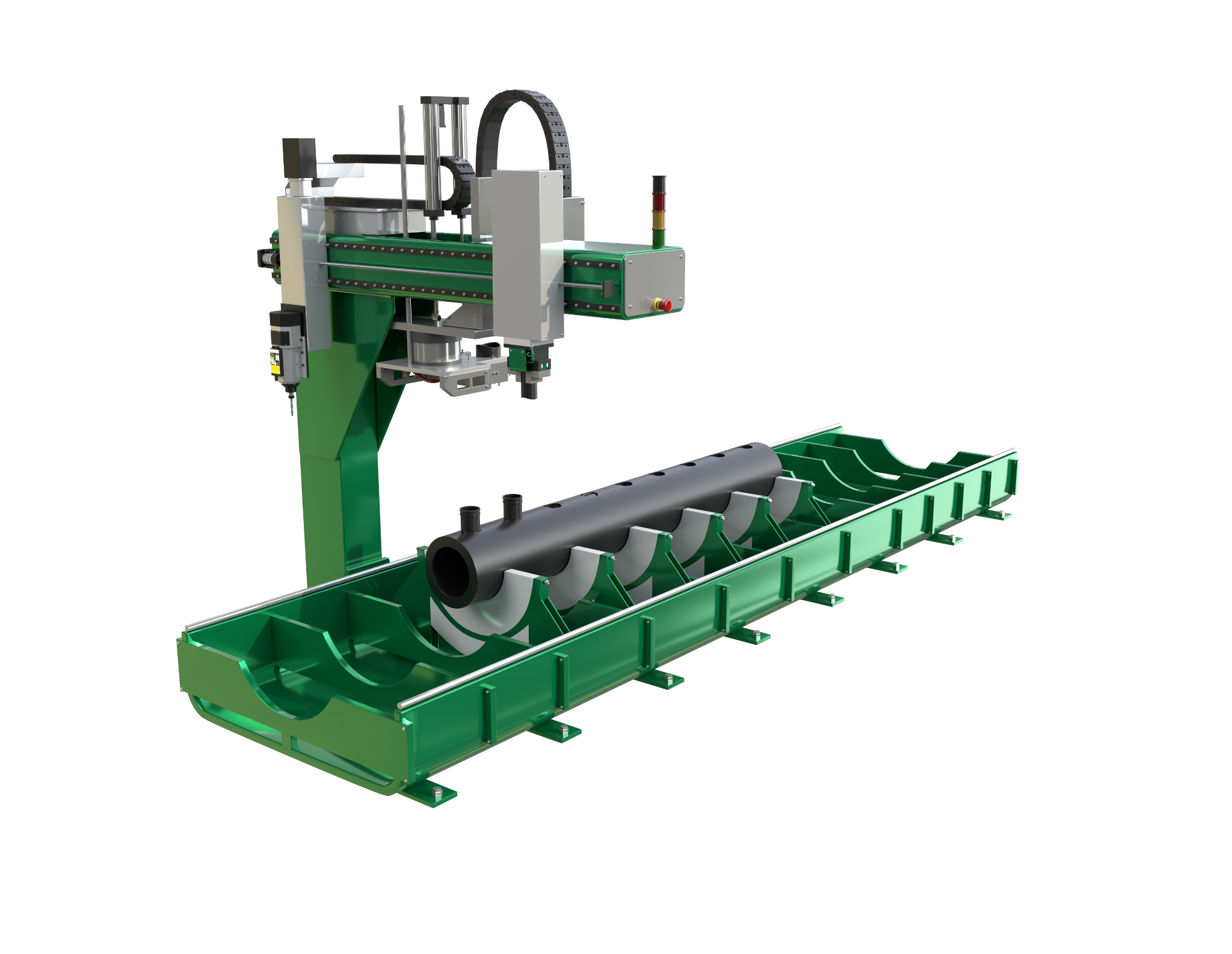
The EX3 plus extrusion welder melts and extrudes plastic filler to form strong weld seams. Its extrusion speed adjusts to suit different welding requirements and operating conditions. Extrusion welds must be leak-proof and finished clean for a durable exterior. The MAW7000 mechanical arm machine, sized 7000 × 3000 × 2000 mm, welds internal and external water-tank joints along the X, Y, and Z axes. This reach suits long baffle runs.
Top Cover and Fittings
Top covers of 1/2″ PT3 polypropylene are fused to the tank walls and longitudinal partitions. Each cover sits recessed 3/8″ from the tank top and is secured with 2″ polypropylene hold-down dowels spaced up to 48″ apart, plus at least two lifting dowels. Fittings assemble as separate components: a combination vent/manual fill tower with a removable screen and hinged cover, an internal vent/overflow pipe routed to discharge behind the rear wheels per NFPA 1901, a sump with anti-swirl plate and cleanout/drain fitting, and tank fill and suction connections.
Flange welding secures inlets, outlets, drains, and vents. Each opening must be accurately located, prepared, and welded to ensure a sound connection without weakening the tank structure.
|
Method / Equipment |
Function |
|---|---|
|
SWT-FS250 flange welding machine |
Pipe-to-flange welding, 140–250 mm range |
|
IRW-250 infrared fusion welding machine |
Pipe and fitting butt welding, 110–250 mm range; smaller weld bead, better appearance, higher weld quality |
|
SWT-JD2015 CNC rubber gasket cutter |
Automatically cuts EPDM flange gaskets for consistent preparation |
Tank Inspection and Quality Control
Visual and Dimensional Checks
Inspection begins as soon as the last weld cools. Walk the tank and examine every weld bead along its full length. Look for cracks, undercut, and porosity with the eye before any instrument. The acceptance criteria are specific and leave little room for judgment.
|
Inspection Item |
Visual Acceptance Criterion |
|---|---|
|
Weld cracks |
Not permitted — any crack is a rejectable defect |
|
Undercut (material < 1 in thick) |
Shall not exceed 1/32 inch |
|
Visible piping porosity |
Shall not exceed 3/8 inch in any linear inch of weld |
A crack rejects the weld on sight. Undercut on sheet under 1 in thick may not exceed 1/32 inch. Visible piping porosity may not exceed 3/8 inch in any linear inch of weld. Mark every defect and repair it before dimensional work starts.
Dimensional checks compare the finished tank against the tank drawing. Confirm overall length, width, and height. Verify baffle positions, fitting locations, and flange orientation. Check that the top cover sits recessed as designed and that hold-down dowels land at the specified spacing. A tank that meets the drawing fits the truck body without field modification.
Leak and Weld Integrity Testing
Leak testing proves the tank holds water under service conditions. Fill the tank with water and inspect every seam, flange, and fitting connection for weeping or damp spots. Watch the extrusion-welded baffle joints closely, since these carry load and resist sloshing. An air pressure test offers a second method for suspect areas. Seal the opening, apply low pressure, and check for pressure loss or bubble formation at the joint.
Weld integrity checks confirm the seam fused through its full thickness. Probe the bead, inspect the weld toe, and confirm the extrusion weld bonded to both surfaces. Confirm gaskets cut on the SWT-JD2015 CNC rubber gasket cutter seat flat and align with their flanges. A misaligned gasket leaks regardless of weld quality.
Inspection closes the loop on the step-by-step process. Sheet selection, cutting, fit-up, and welding all converge at this stage. A tank that passes inspection protects the final product and the crew that depends on it.
Fire Truck Water Tank Welding Solutions
Essential Welding Equipment
A complete fire truck water tank welding solutions lineup covers every stage from raw sheet to finished tank. The table below maps each machine to its role.
|
Stage |
Equipment |
Function |
|---|---|---|
|
Cutting |
SWT-XL5000 automatic sheet saw |
Cuts sheets to size with square, repeatable edges |
|
Cutting |
SWT-YF2040 CNC router |
Carves shapes and openings on sheets |
|
Body fusion |
SWT-PH7000 sheet butt fusion welding machine |
Welds thermoplastic sheets; supports horizontal, circular, and 90° vertical jointing |
|
Body forming |
SWT-ZW7000 sheet bending welding machine |
Bends thermoplastic sheets from 0 to 95 degrees |
|
Baffle extrusion |
EX3 plus extrusion welder |
Melts and extrudes plastic filler for strong seams; adjustable extrusion speed |
|
Hot air work |
CX1600S BL hot air welder |
Hot air welding of plastics |
|
Hot air work |
SWT-NS2000 hot air welder |
Hot air welding with a split design for flexibility |
|
Pipe and fitting fusion |
IRW-250 infrared fusion welding machine |
Butt welds pipes and fittings via infrared heating, 110–250 mm range; smaller weld bead, better appearance, higher quality |
|
Internal and external joints |
MAW7000 mechanical arm machine |
Welds internal and external tank joints along X, Y, and Z axes; 7000 × 3000 × 2000 mm |
|
Flanges |
SWT-FS250 flange welding machine |
Pipe-to-flange welding, 140–250 mm range |
|
Gaskets |
SWT-JD2015 CNC rubber gasket cutter |
Automatically cuts EPDM flange gaskets for consistent preparation |
The SWT-PH7000 anchors the body stage. Its maximum welding length reaches 7,000 mm, and it handles sheet thickness from 3.0 mm to 50.0 mm. A delta servo motor and precision lead screw move the heating plate with accuracy to 0.01 mm.
Building a Coordinated Workflow
Each tool feeds the next. The saw and router produce accurate panels. The butt fusion and bending machines form the shell. The extrusion welder and mechanical arm secure baffles. The infrared and flange machines finish pipe connections, and the gasket cutter prepares seals. Engine-driven welding solutions allow remote adjustment of amperage and voltage, plus customizable welding programs, which supports flexible field work.
A coordinated, end-to-end workflow reduces rework and improves tank reliability. Panels cut to drawing fit without trimming. Joints prepared at the bench weld cleanly in place. Every stage inherits accuracy from the one before it, and the finished tank reflects that discipline.
The path to a dependable tank follows four steps in order. Select PP sheet with verified thickness, density, and UV data. Cut and machine panels square, then deburr and clean every edge. Assemble and weld the body, baffles, top cover, and fittings in sequence. Finish with visual, dimensional, and leak testing.
A coordinated solution ties these stages together. The right material, the matched cutting and welding equipment, and disciplined technique all matter equally. Apply this step-by-step approach to your fire truck water tank welding solutions. Quality at every stage produces a durable, safe tank that performs when the call comes.
FAQ
Which machines cut and shape PP sheets before welding?
The SWT-XL5000 automatic sheet saw cuts sheets to the desired sizes with square, repeatable edges. The SWT-YF2040 CNC router carves the desired shapes on sheets, including fitting openings.
What joins the tank body panels and forms the corners?
The SWT-PH7000 sheet butt fusion welding machine welds thermoplastic sheets made of PE, PP, PVC, PVDF, PC, ABS, and acrylic. It supports horizontal and circular welding, plus 90-degree vertical jointing on request. The SWT-ZW7000 sheet bending welding machine bends thermoplastic sheets from 0 to 95 degrees to form corners and shaped sections.
How are baffles and internal joints welded?
The EX3 plus extrusion welder melts and extrudes plastic filler to form strong weld seams. Its extrusion speed adjusts to suit different welding requirements and operating conditions. The MAW7000 mechanical arm machine, sized 7000 × 3000 × 2000 mm, welds internal and external water-tank joints along the X, Y, and Z axes.
Which tools handle pipe connections and flange gaskets?
The IRW-250 infrared fusion welding machine butt welds pipes and fittings across a 110–250 mm range. It produces a smaller weld bead, better appearance, and higher welding quality. The SWT-FS250 flange welding machine supports pipe-to-flange welding in the 140–250 mm range. The SWT-JD2015 CNC rubber gasket cutter automatically cuts EPDM flange gaskets for consistent preparation.
Where do the hot air welders fit into the workflow?
The CX1600S BL hot air welder performs hot air welding of plastic materials. The SWT-NS2000 hot air welder does the same work, and its split design makes it more flexible. Both support joint preparation and detail work around baffles, fittings, and seams.