Large-diameter socket fusion creates three common failures. A fitting resists the push. The joint enters crooked. The pipe sinks too deep and chokes the flow.
Each failure costs time and money. Workers feel the strain on every large joint. Quality varies from one operator to the next. A bench socket fusion machine moves the work into a controlled workshop. The MM-Tech TSC Series is built for this exact job.
The machine uses mechanical drive and guide rails. It controls insertion depth with hard stops. Manual fusion leaves too much to chance. This article explains what the machine is, how it fixes each failure, and where it proves its worth on real projects.
Key Takeaways
The TSC Series stops push failure with a rack-and-pinion drive and handwheel. This makes large-diameter fusion easy for one operator.
Guide rails and central clamping blocks help ensure correct alignment, stopping misaligned joints and cold welds.
Adjustable depth stops keep fittings from going in too far. This keeps the pipe opening clear and allows full flow.
The machine makes joints that always come out good and strong, using many materials and sizes, so workers get more done and fix fewer mistakes.
Real-world success in Saudi Arabia shows no leaks and passed audits. This proves the TSC Series is reliable even in tough conditions.
What Is a Bench Socket Fusion Machine?
Definition and Core Positioning
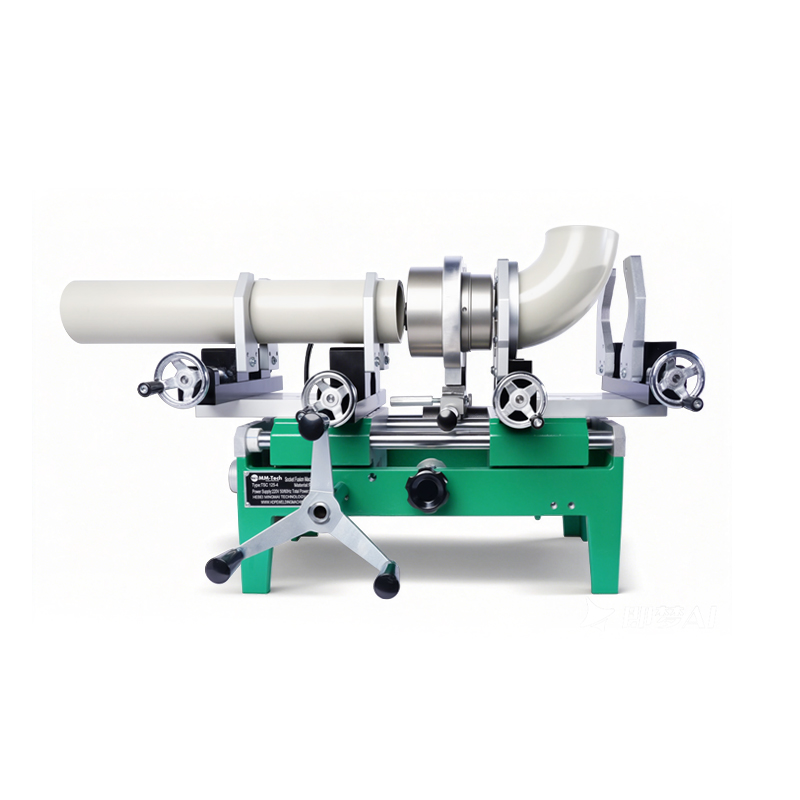
A bench socket fusion machine is a high-precision benchtop system made for workshop prefabrication of thermoplastic pipes. It uses a precision mechanical transmission system to get rid of three chronic problems: physical strain, misaligned insertion, and flow-blocking over-insertion. The machine holds the pipe and fitting on a single axis. A handwheel pushes the pipe forward. Hard stops control the depth. This design takes away the guesswork that troubles manual socket fusion welding.
MEP contractors and pipe fabrication facilities see this equipment as an essential asset. The reason is simple. Output and quality both go up when workers move fusion work off the job site and into a controlled shop environment. A bench socket fusion machine lets a single operator finish joints that once needed a crew. The machine also enforces repeatability. Every joint follows the same mechanical path. That consistency protects the contractor’s reputation and cuts down on rework.
The TSC Series from MM-Tech fits this role directly. It is not a general-purpose welder. It is a dedicated socket fusion machine built for high-frequency production. Shops that run large-diameter work benefit most. The mechanical frame carries the load. The operator guides the process. This division of labor keeps quality high across long shifts.
Models and Specifications
MM-Tech offers three models in the TSC Series. Each one covers a specific band of pipe sizes. Together they span a working range of 20mm to 160mm (1″ to 6″ IPS). The table below summarizes the key parameters.
Model | Working Range | Rated Power |
|---|---|---|
TSC-90 | 20mm to 90mm | 1200W |
TSC-125 | 20mm to 125mm | 1400W |
TSC-160 | 20mm to 160mm | 1800W |
These power ratings match industry norms. Benchtop socket fusion machines rated for pipe up to 110mm commonly draw 1400W or 800W, depending on design. The TSC-160 draws 1800W to handle the largest sockets in its range.
The machine works with a broad set of compatible pipe and fitting material. That list includes PP-R, PE, PP, PB, and PVDF. An hdpe pipe also falls within the PE family and suits the process. Shops that run multiple polymers do not need separate machines. One TSC unit covers the full material range.
Compliance matters in regulated markets. The TSC Series meets DVS 2208-1 standards. This guideline governs socket fusion welding parameters and equipment behavior. An intelligent temperature control system maintains working temperatures between 200°C and 279°C with ±1% accuracy. That precision keeps the heating cycle stable. A stable heating phase produces a proper melt. A proper melt yields a strong joint after cooling.
The machine runs on AC110V/220V, 50/60Hz power. A removable tripod stand adds convenience on construction sites and flat surfaces. The stand supports the pipe during welding. MM-Tech backs the TSC Series with a 2-year quality warranty, technical support, and CE certification.
How It Solves Socket Fusion Welding Failures
Solving Push Failure
Manual socket fusion welding on pipes above 63mm takes a lot of physical strength. Operators have a hard time pushing the pipe into the fitting against tight friction. This often causes tiredness and uneven results. The TSC Series socket fusion machine removes this struggle with a rack-and-pinion drive and a high-torque handwheel. The process of socket fusion welding becomes easy. One operator turns the wheel and slides the pipe smoothly into the socket.
Solving Misalignment and Over-Insertion
Misalignment is a common problem in socket fusion welding. Uneven manual force pushes the pipe into the socket at an angle. This creates a cold weld that can fail under pressure. The TSC fixes this with industrial linear guide rails and central clamping blocks. These parts lock the pipe and fitting on a single axis, so alignment is perfect. Guide rails are key for socket fusion. The guide rails keep the socket aligned. The socket and pipe meet on a single axis. Mechanical guidance is the key to reliable socket fusion. The TSC makes sure force spreads evenly in all 360°. Uneven fusion leads to weak spots. The TSC makes sure fusion is even. The fusion pressure is controlled. Mating is precise.
Over-insertion is a serious mistake in socket fusion welding. Pushing the pipe too deep forces melted plastic into the inner bore. This blocks water flow and lowers system pressure. A good socket fusion weld needs exact depth. Exact depth is key for socket fusion. The TSC uses adjustable mechanical stops. The operator pushes the pipe until the stop halts the carriage at the exact mark. The depth stop keeps the socket from being overstressed. The fusion depth is exact. The fusion result can be repeated.
Premium Teflon-coated heating dies help with these precision steps. A clean release makes sure fusion works well for socket fusion welding. The heating surface spreads temperature evenly. The heating cycle is set for quick recovery. The PTFE coating stops melted polymer from sticking to the die during heating. Steady heating is vital for socket fusion. The dies resist wear during heating. This makes them last longer. The molecular bond is strong. During cooling, the polymer molecules lock into place. This creates high joint strength. The TSC turns a hard manual task into a reliable socket fusion process by controlling the whole fusion cycle the same way every time. The machine gives the same quality on a 20mm hdpe pipe as on a 160mm PVDF pipe.
Where Socket Fusion Prefabrication Delivers Results
Building, Chemical, and HVAC Applications
Building plumbing systems depend on prefabricated PPR potable water mains and distribution lines. Commercial complexes, high-rise residential buildings, hospitals, and hotels all need these networks. On-site places like basements and utility shafts are cramped and dark. Setting up a TSC unit in a climate-controlled workshop to pre-assemble pipe spools before hoisting boosts efficiency by a huge amount. Workers do socket fusion welding in comfort. They make consistent joints without the strain of field work.
Chemical process and ultra-pure water piping need exceptional cleanliness. PVDF and PP chemical delivery networks serve semiconductor wafer fabs and pharmaceutical plants. PVDF requires smooth inner joints with no dead zones. The TSC’s strict alignment and precise depth stop produce clean inner surfaces that meet cleanroom standards. Each socket fusion welding pass makes a joint free of internal ridges. This protects product purity.
District heating and cooling systems use PE and PB media circulation piping loops. These HVAC networks face constant thermal expansion and contraction. Weak points risk bursting under cyclic stress. The TSC’s firm mechanical alignment and controlled joining pressure create a dense molecular bond. This strong and reliable bond extends system lifespan. A successful socket fusion weld here means decades of reliable service.
Case Study: Saudi Arabia
In Riyadh, a top-tier international contractor built a luxury commercial and office development. The project specified large-diameter PPR piping in 75mm, 90mm, and 110mm sizes. Outdoor temperatures exceeded 45°C (113°F). The contractor set up an indoor prefabrication workshop to protect workers and maintain deadlines.
Joining 110mm PPR pipes required overcoming severe interference fits. Project specs strictly prohibited internal bead overflow. The contractor deployed multiple MM-Tech TSC Series machines to establish a high-output assembly line. A 110mm PPR joint previously requiring three workers was completed smoothly by a single operator turning a handwheel. The depth stop ensured textbook full-bore flow profile. Heavy-duty guide rails ensured 100% concentricity.
After two months of prefabrication, thousands of socket joints passed a 48-hour hydrostatic pressure test with zero leaks. The system passed the strict Saudi quality audit on the first attempt.
“Welding large-diameter PPR pipes in Saudi Arabia’s extreme climate is a major challenge, and MM-Tech’s TSC benchtop socket machine saved our project schedule. Its mechanical frame is extremely solid, and the handwheel drive requires minimal effort. What impressed us most was the welding accuracy—the insertion depth control was spot-on, with zero internal blockages. The entire system passed hydrostatic testing with zero leaks. This machine proved to be our most reliable prefabrication tool on site!”
The TSC Series handles socket fusion welding for hdpe pipe, PP, PB, and PVDF with equal precision. Each fusion cycle follows the same controlled heating and cooling profile. This consistency delivers repeatable quality across every joint.
The TSC Series gives clear business value. Workers feel less tired. Large-diameter joint quality stays the same. Prefab output goes up. The bench socket fusion machine removes push failure, misalignment, and over-insertion using mechanical precision. Guide rails, depth stops, and controlled heating take the place of manual guesswork. Every socket fusion welding pass follows the same path. Operators trust the socket fusion process because the machine controls each variable. The heating cycle stays steady. Each socket meets the standard.
Contractors who use this socket fusion method get a real edge. They should ask for the full specification sheet, book a live video demo, or get advice on setting up a prefab line. The TSC Series turns fusion work into a repeatable, high-output operation.
FAQ
What pipe sizes does the TSC Series cover?
The three models cover 20mm to 160mm (1″ to 6″ IPS). The TSC-90 works up to 90mm, the TSC-125 goes to 125mm, and the TSC-160 handles the full 160mm range. Each unit fits different production needs.
Which materials work with this machine?
The TSC Series welds PP-R, PE, PP, PB, and PVDF. An hdpe pipe is part of the PE family and works with the process. One machine handles many polymers, so shops don’t need to buy separate units for each material type.
How does the machine prevent over-insertion during socket fusion welding?
Adjustable depth stops stop the carriage at the exact mark. The operator pushes until the mechanical limit stops movement. This keeps melted plastic out of the inner bore. Every socket fusion welding pass gives a full-bore flow profile.
Can one operator run the machine alone?
Yes. A rack-and-pinion drive and high-torque handwheel let one operator finish joints that once needed three workers. The mechanical frame carries the load. The operator guides the socket into place with very little effort.
What support does MM-Tech provide?
MM-Tech offers a 2-year quality warranty, technical support, and CE certification. The company gives pre-sales guidance, personalized support, and training. A removable tripod stand adds convenience for site work. The fusion process stays reliable with the right backing.